Fine motor activities are play and everyday tasks that help children use the small muscles of their hands, fingers, and wrists together with their eyes. For toddlers and preschoolers, practice often comes through ordinary routines and play: picking up a bead, peeling a sticker, placing a lid, or using a spoon.
What fine motor activities build before writing and dressing
Fine motor skills combine small-muscle movement with vision for precise actions. They also include movements of the lips, tongue, and eyes. At the beginning are six building blocks: reach, point, touch, grasp, place, and release. Children later combine them to button clothing, write on a line, or manage utensils.
The Big 6+6 framework adds twist, pull, push, tap, squeeze, and shake, totaling 12 discrete movements. Opening a container, for example, may involve reaching, grasping, twisting, and releasing the lid.
The six essential fine motor skills often cited for preschoolers are pincer grasp, hand-eye coordination, finger dexterity, scissor skills, writing readiness, and drawing abilities. Fine motor precision is the hand’s ability to coordinate an efficient, targeted movement with a precise goal.
20 everyday fine motor actions children can practice
Use this list as a menu, not a test. Pick one or two actions that fit what your child is already interested in, then repeat them in real routines and play.
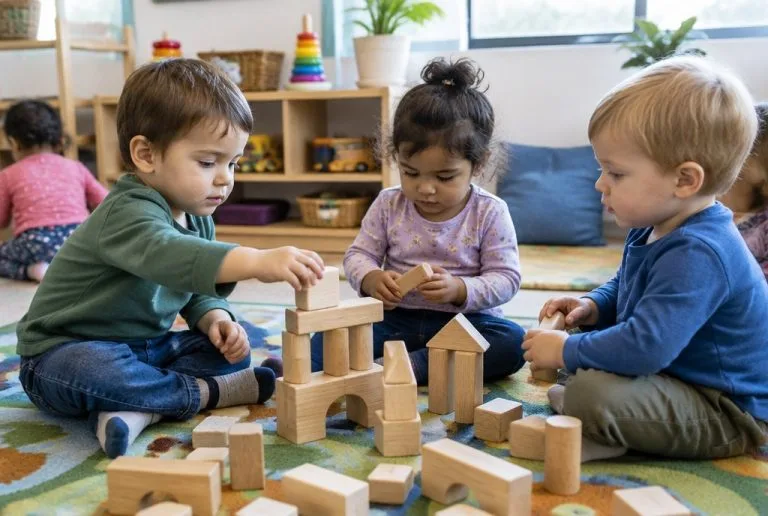
- Stack blocks into a tower.
- Cover and uncover containers.
- Place round pegs into holes.
- Scribble or paint with chunky crayons.
- Turn one page at a time.
- Eat with a spoon.
- Use a fork.
- Turn a doorknob.
- Wash hands.
- Zip and unzip.
- Place lids on containers.
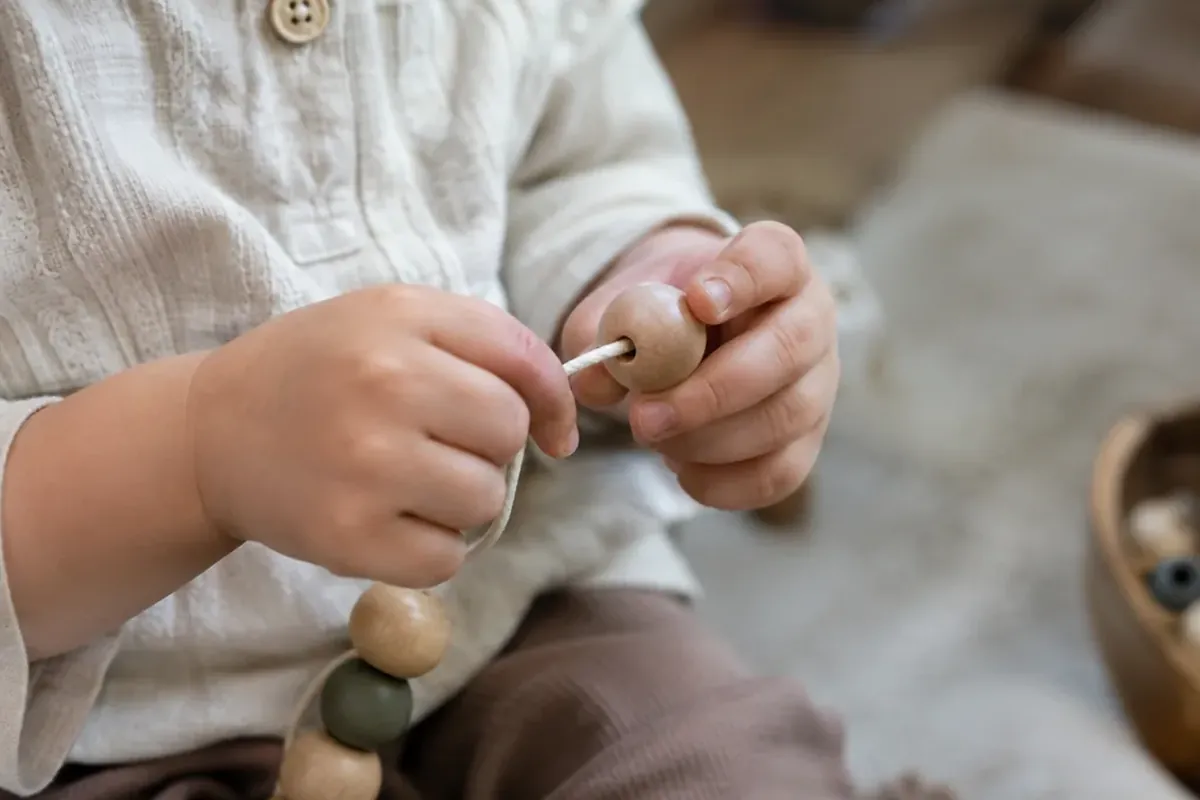
- String large beads or pasta on yarn.
- Peel and place stickers.
- Scoop and pour water or sand.
- Fold paper with supervision.
- Make shapes from clay.
- Button and unbutton clothing.
- Trace shapes.
- Cut paper with scissors.
- Complete a simple puzzle.
These actions use different combinations of grasp, release, visual-motor coordination, and two-hand use. A child who threads a bead holds the string steady with one hand while guiding the bead with the other; that bilateral coordination is a precursor to skills such as writing.
Choose fine motor activities for your child’s stage
| Approximate age | What you may see | Play ideas |
|---|---|---|
| 12–24 months | Block towers, scribbling, spoon use, turning pages, and a fingertip pincer grasp with a crayon | Stack blocks, uncover containers, fit round pegs, scribble, and paint. |
| 2–3 years | Using a spoon and fork, zipping, placing lids, stringing beads, and drawing a circle by age 3 | Use chunky or triangle crayons, string large beads or pasta, peel stickers, and scoop or pour. |
| 3–4 years | Buttoning, cutting paper, tracing shapes, and a static tripod or quadrupod grasp | Squeeze spray bottles or tongs; trace, color, connect dots, and use chunky puzzles or pegboards. |
| 4–5 years | Drawing a square, cutting a straight line and simple shapes, and using utensils neatly | Place beads on pegboards, cut simple shapes, and apply glue to small craft targets. |
| 5–6 years | A more efficient dynamic tripod or quadrupod grasp for handwriting | Shape putty, copy stars or diamonds, write names and numbers, and play card or board games. |
Age ranges describe a developmental sequence, not a scorecard. For drawing, children commonly imitate vertical strokes around 18–24 months, horizontal strokes around 24–30 months, draw a circle by age 3, and draw a cross at about 4 years 1 month.
Build hand strength with dough, tongs, and clothespins
Play-dough gives hands repeated resistance: rolling, pinching, squeezing, and pressing work the small muscles in the hand. Hide small objects in a dough ball for your child to dig out, or roll a dough “snake” and pinch tiny spikes onto a hedgehog to strengthen pincer grasp and finger isolation.
A garlic crusher can turn dough into “worms,” while a rolling pin, cookie cutters, plastic knife, and child-safe scissors introduce different movements. Dough is also a useful first cutting material because it stays in place and offers resistance while a child learns the open-close motion.
For a squeezing game, start tongs or tweezers with cotton balls and progress to beads moved between bowls. Squeezing tongs or clothespins isolates the thumb, index finger, and middle finger while the ring finger and pinky stay tucked away—the same finger pattern used with scissors. Try clipping clothespins to a board book as “legs.”
Turn routines into fine motor skill activities
Everyday tasks give fine motor practice a purpose. During meal preparation, let your child stir, mix, and pour ingredients. At the table, they can set out utensils. Pouring water from a small pitcher into a cup and spooning rice or sand between containers call for control, precision, and bilateral coordination.
Getting dressed creates another chance to practice. Begin with large buttons and loose-fitting clothes. With backward chaining, you complete most of the task and your child finishes the last step, gradually taking on more steps over time. For threading, begin with large beads or pasta on a pipe cleaner or shoelace, then reduce the size as skill grows. If guiding the string is hard, tape wool around its end to make a firmer “needle.”
Drawing need not mean letter drills. Most letters begin with basic shapes, so vertical, horizontal, and circular lines come first. Paper taped to a wall, a chalkboard, or an easel builds wrist stability and shoulder strength for later pencil control. Short or broken crayons encourage fingertips instead of a whole-fist grip.
Make activities easier or harder without taking over
To adapt activities, start with larger materials such as big beads, thick crayons, and wide lines, then gradually make them smaller as skill grows. Child-sized tools—including small scissors, chunky crayons, and age-appropriate utensils—reduce frustration and support success.
Backward chaining can also be used across other challenging fine motor tasks: the adult completes most of the task while the child finishes the final step, building up to more steps as confidence grows.
What parents often misunderstand about fine motor development
Myth: More handwriting is the fastest route to pencil control
Handwriting readiness also depends on hand and finger strength, hand-eye coordination, bilateral integration, upper-body strength, and object manipulation. Play with dough, tongs, threading, and cutting strengthens the hands first; it is not separate from pre-writing practice.
Myth: A neat pencil grasp should come early
Grasps change over time. A toddler may hold a crayon in a whole fist at 12–15 months, move to fingers pointing down at 2–3 years, and use a static tripod or quadrupod grasp at 3–4 years. The dynamic tripod or quadrupod grasp, in which the fingers move to control the utensil, is the most efficient grasp for handwriting and develops around 5–6 years.
Myth: Scissor practice starts with cutting shapes
Scissor skills develop in stages. Children may show interest and manipulate scissors around 2–2½ years, make single snips at 2½–3, and begin cutting forward along a 6-inch line at 3. Before paper cutting, try tearing paper, a hole puncher, a spray bottle, tongs, or clothespins. When cutting, “thumb up to the sky” helps orient the scissors.
When a fine motor concern deserves a healthcare conversation
Talk with a healthcare provider if a baby is not using a pincer grasp to pick up small items with thumb and index finger by 12 months corrected age. Frequent dropping, difficulty holding a spoon or toothbrush, or trouble with coloring, writing, scissors, or shoe tying are also reasons to ask for guidance.
Persistent fisted or very tight hands beyond 6–7 months, or a clear hand preference before 12 months, are red flags. A child who struggles with fine motor tasks, visual motor skills, or self-care activities such as feeding, picking up small objects, or buttoning may benefit from occupational therapy.
Frequently Asked Questions
What are fine motor activities for toddlers?
For toddlers, fine motor activities include stacking blocks, scribbling with chunky crayons, using a spoon, turning pages, fitting round pegs into holes, peeling stickers, and scooping or pouring.
What are five examples of fine motor skills?
Holding a pencil, cutting with scissors, buttoning a shirt, threading beads, and using a spoon or fork are five examples.
What are the Big 6 fine motor skills?
The Big 6 movements are reach, point, touch, grasp, place, and release. They are building blocks for more complex tasks.
What activities help improve hand strength and coordination?
Rolling, pinching, squeezing, and pressing play-dough build hand strength. Tongs, tweezers, clothespins, bead threading, pouring, and cutting practice coordination skills in different ways.
How can I adapt fine motor activities for preschoolers?
Start with larger materials such as large beads, thick crayons, and wide lines, then make them smaller as skill grows. Child-sized tools and backward chaining can make a task manageable while preserving the child’s role in it.